
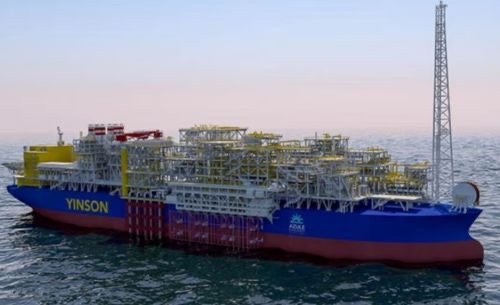
Malaysian energy services company Yinson Production and Italian oil major Eni plan to invest in expanding gas export capacity at Ghana’s Sankofa field, in a project valued at approximately $810 million aimed at sustaining supplies as reservoir pressure declines.
The expansion will increase the gas export capacity of the John Agyekum Kufuor floating production, storage and offloading (FPSO) vessel to 355 million standard cubic feet per day, from its current capacity of around 210 million to 220 million cubic feet, Yinson said.
The project forms part of an amendment to the vessel’s charter, operation and maintenance contract announced on October 5. The amendment adds approximately $810 million in contract value, of which $600 million is attributable to Yinson Group.
Eni operates the Offshore Cape Three Points (OCTP) project, which includes the Sankofa field, while Yinson operates the FPSO vessel used to produce and process hydrocarbons offshore.
The companies expect to complete the expansion in the first quarter of 2028.
The work involves installing two additional modules on the vessel’s topside facilities. One, known as MG2, will house two gas turbine-driven compressors, while the second, MC4, will provide additional gas treatment capacity.
The new equipment is designed to compensate for declining reservoir pressure, helping maintain gas flows and extend the economic life of the offshore asset.
The contract amendment also extends the FPSO’s firm charter period by four years, through 2036, providing a longer operational horizon for the vessel and the associated field development.
However, the higher export capacity does not guarantee a corresponding increase in actual gas production or deliveries to Ghana. Volumes will depend on reservoir performance, operating conditions, domestic demand and the availability of infrastructure to transport and consume the gas.
Critical supply for power generation
The Sankofa development is an important source of domestic gas for Ghana, where the fuel supports electricity generation and industrial activity.
Eni said in July 2025 that the OCTP project supplied around 70 percent of Ghana’s domestic gas requirements, with its gas fuelling power plants that generated approximately 34 percent of the country’s electricity.
The project has undergone successive upgrades to increase processing capacity. In July 2025, Eni announced that OCTP’s gas processing capacity had risen to 270 million standard cubic feet per day from 246 million.
The latest expansion is intended to help sustain gas flows as pressure in the reservoir weakens, although compression technology cannot by itself guarantee that production will remain at current levels.
Ghana faces the challenge of securing sufficient and reliable gas supplies to meet the needs of power producers and industrial consumers while maintaining the infrastructure required to transport fuel from offshore fields.
In June, Hamis Ussif, deputy chief executive for finance, commercial and administration at the Ghana National Petroleum Corporation (GNPC), emphasised the importance of continued investment in upstream development and gas infrastructure to meet growing demand.
The Sankofa expansion comes amid broader efforts to strengthen the country’s gas supply through investment in producing fields and transportation systems.
Infrastructure and payment risks
The planned increase in export capacity also highlights the importance of matching gas production with the ability of domestic consumers to use the fuel.
Ghana has previously faced financial pressures under take-or-pay gas purchasing arrangements, which can require payment for contracted volumes even when the buyer cannot use the full supply.
In January 2019, the Energy Ministry reported that Ghana was paying approximately $28 million a month for gas it could not use, largely because of insufficient transportation and consumption capacity at the time.
The ministry said the unused gas was not lost to the state and could be supplied later when the necessary infrastructure became available.
That experience illustrates the financial risks of expanding gas supply without ensuring that pipelines, power plants and industrial users can accommodate the additional volumes.
For Ghana, the benefits of the Sankofa investment will therefore depend not only on the technical success of the expansion but also on reservoir performance, domestic consumption and the capacity of the wider gas network.
The planned upgrade could strengthen the country’s ability to manage declining reservoir pressure and support gas production over a longer period. But the increase in processing and export capacity should not be interpreted as a guaranteed rise in deliveries or an equivalent reduction in supply constraints.
With completion targeted for early 2028 and the FPSO charter extended through 2036, the project represents a long-term commitment to Ghana’s offshore gas infrastructure as the country seeks to secure fuel for electricity generation and industry.
Source: africabusinessinsight.com