
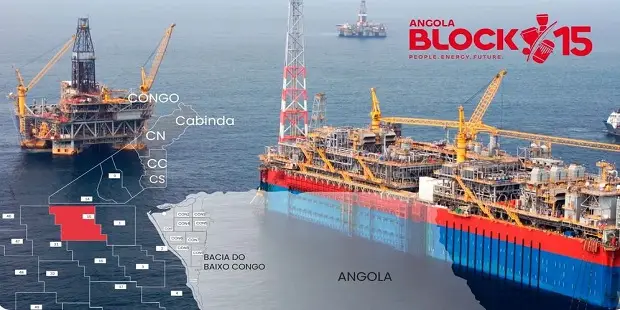
ExxonMobil announced the Tchihumba West-1ST1 discovery within two months of the Vicango East-1 discovery, in its prolific Block 15, offshore Angola.
Both finds were made in the context of Angola’s Marginal Oilfield Incentive, though the drilling was also driven by Block 15’s acreage expansion and improved operating terms.
Tchihumba West-1ST1 exploration well encountered “65.4 metres of sand reservoir with the presence of hydrocarbons and good petrophysical properties”, according to Angolan National Agency for Petroleum, Gas and Biofuels (ANPG). It is located approximately 350 kilometres northwest of Luanda, having been drilled by the Valaris DS-9 drillship, in a water depth of approximately 1,400 metres. The Vicango East-1 had in September 2026 been reported as encountering 25 metres of hydrocarbon-bearing sandstone with 22% porosity, drilled in roughly 940 metres of water using the same rig: the Valaris DS-9.
The two probes are the 20th and the 21st discoveries in the block, which has produced 2.7Billion barrels of oil since first oil in 2003.
ExxonMobil originally discovered Vicango and Mbulumbumba in 2001 and Tchihumba in 2003, ceded them to the state around 2022. Angola’s National Agency for Petroleum, Gas and Biofuels (ANPG) then went ahead to list Tchihumba and Vicango (alongside Xikomba and Mbulumbumba) among prospects under Angola’s marginal fields initiative, established primarily under Presidential Legislative Decree 6/18 (and later complemented by incremental production incentives) providing reduced tax rates, improved cost recovery, and lower government profit shares to make smaller or less profitable oil discoveries commercially viable.
But ExxonMobil came back to have them reincluded by expanding Block 15 acreage in September 2025, responding to improved operating terms for exploration and development, alongside a production-sharing agreement extension through 2037
Tchihumba West-1ST1 was drilled to target prospects west of the Tchihumba-1, discovered in 2003 and Vicango East-1 was drilled east of Vicango-1, discovered in 2001.
Source: africaoilgasreport.com