
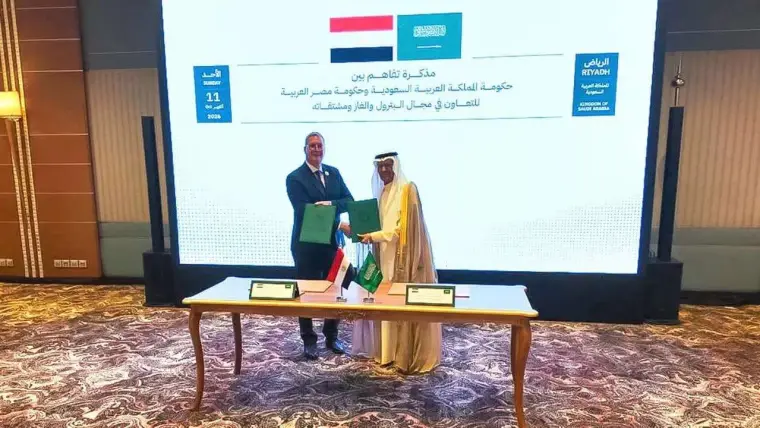
Egypt and Saudi Arabia signed a memorandum of understanding (MoU) to strengthen bilateral cooperation in oil, natural gas and petrochemicals, opening new avenues for energy-sector integration, investment and trade between the two countries.
The agreement was signed by Egypt’s Minister of Petroleum and Mineral Resources, Karim Badawi, and Saudi Arabia’s Minister of Energy, Prince Abdulaziz bin Salman bin Abdulaziz Al Saud, at the conclusion of the 17th Ministerial Meeting of the International Energy Forum in Riyadh.
The memorandum aims to broaden cooperation between the two countries’ petroleum and energy sectors by leveraging their respective resources, technical expertise and infrastructure capabilities.
Strengthening Oil and Gas Supply Chains
Under the agreement, Egypt and Saudi Arabia will expand cooperation in the trading, handling, transportation, storage and distribution of crude oil, petroleum products and natural gas.
The framework also covers the development of infrastructure and logistics services associated with these activities, with a focus on improving energy-market efficiency, strengthening supply-chain resilience and reliability, and supporting energy security.
Closer coordination in these areas could create opportunities to improve the movement and distribution of energy products while reinforcing commercial links between the two markets.
New Opportunities in Petrochemicals and Investment
Petrochemicals are another central pillar of the agreement, with both countries seeking to explore investment opportunities in joint projects and support export growth.
The memorandum also provides for the exchange of expertise and best practices in the operation and development of fuel stations, as well as the transportation and tracking of petroleum products and liquefied petroleum gas (LPG) cylinders.
These initiatives are intended to enhance operational practices, improve distribution systems and expand cooperation across the petroleum value chain.
Technical Cooperation and Knowledge Exchange
Beyond trade and investment, the agreement establishes a framework for exchanging technical information and expertise through mutual visits, training programs, conferences and workshops.
The initiatives are designed to facilitate knowledge transfer, strengthen technical capabilities and encourage closer professional cooperation between the two countries’ energy-sector institutions.
By expanding opportunities for technical collaboration, the two sides aim to support the development of expertise and identify additional areas of mutual interest across oil, gas and petrochemicals.
Source: see.news