
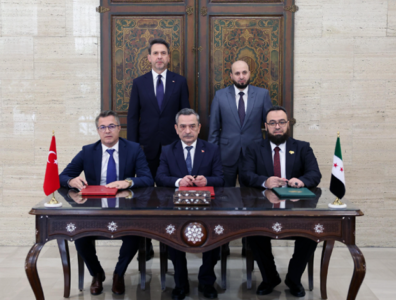
On Wednesday, Turkish Minister of Energy and Natural Resources, Alparslan Bayraktar held a joint press conference with his Syrian counterpart, Mohammed al-Bashir, in Damascus. The primary topic of discussion was Turkey’s readiness to begin upstream activities in Syria, both through the state-owned Turkish Petroleum Corporation (TPAO) and private firms – whom Bayraktar stated would be ready to get to work “immediately”.
Aside from exploration, seismic surveys, and both offshore and onshore drilling, the countries discussed plans to triple electricity transmission between them to over 800MW. Joint infrastructure projects are expected to be commissioned in the coming weeks.
Turkey’s state-owned mining company MTA IC and Syria’s General Directorate of Geology and Mineral Resources also signed an MoU on phosphate, laying the foundations for potential joint ventures between the countries.
Before thirteen years of civil war and Western sanctions decimated the country’s production capacity, Syria’s oil output was over 300,000 bopd. There has been a slight recovery since 2024, but current production is estimated at just 75,000 bopd. Despite the country’s over 2.5 billion barrels of oil reserves, and 240 bcm (8.5 tcf) of gas, Syria has been a net energy importer for the past decade.
From a Syrian perspective, the invitation of external expertise, capital, and capacity are a natural step in the country’s reconstruction and development – and Turkey is not the only interested party. In June, Syria signed a deal with ConocoPhillips and Novaterra to develop new and existing gas fields, aimed at raising gas output to 4 – 5 mcm per day within a year.
For Turkey, it represents an expansion of its regional energy footprint – the country operates a deep sea drilling fleet already active in the Black Sea and off the coast of Somalia, and recently won a license to explore Libyan offshore resources.
source: Turkey and Syria outline plans for oil and gas cooperation – The Energy Year