
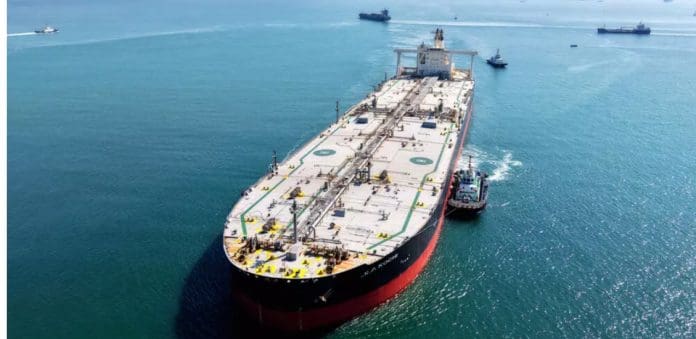
Oil prices retreated from last week’s multi-year highs on Monday as a small number of tankers successfully sailed through the Strait of Hormuz for the first time since the war began, offering traders a first tentative signal that the waterway could partially reopen, though analysts warned that a sustained price retreat remained unlikely without a broader military resolution.
Brent crude futures fell to $102.42 a barrel by midday in New York, down about one percent from Friday’s close, while West Texas Intermediate (WTI) dropped to $95.79 a barrel. Both benchmarks remain more than 40 percent above the levels they traded at before the United States and Israel launched strikes on Iran on February 28.
The easing followed reports that some vessels had successfully transited the strait, and US Treasury Secretary Scott Bessent said Washington was “fine” with certain Iranian, Indian and Chinese ships sailing through for now, adding that any further action to reduce prices would depend on how long the war lasted. Iran separately asked India to release three tankers seized in February as part of informal talks about safe passage for Indian-flagged or India-bound vessels.
The International Energy Agency (IEA) said in its March Oil Market Report that the war had created the largest supply disruption in the history of the global oil market, with tanker flows through the Strait of Hormuz falling to less than ten percent of pre-war levels. Gulf producers including Saudi Arabia, Iraq, Kuwait and the United Arab Emirates had collectively cut output by at least ten million barrels per day by March 10 as storage tanks filled to capacity with oil that could not be shipped to market.
The 400 million barrel emergency reserve release agreed by 32 International Energy Agency (IEA) member nations last Wednesday, the largest coordinated drawdown in the agency’s 50-year history, has done little to dampen prices. At its planned pace, the US contribution of 172 million barrels from the Strategic Petroleum Reserve (SPR) amounts to 1.4 million barrels per day over 120 days, covering just 15 percent of the daily supply lost from the Strait closure. Rystad Energy forecasts Brent reaching $110 a barrel by April if the war lasts two months, and $135 by June if it extends to four months.
IEA Executive Director Fatih Birol said on Monday that member countries could authorise a further release later “as and if needed.” The US Energy Information Administration (EIA) revised its full-year 2026 Brent forecast sharply upward to $79 a barrel from $58, but said the trajectory assumed the conflict would prove temporary and that Liquefied Natural Gas (LNG) flows, currently cut off for approximately 20 percent of global LNG trade, would resume.
Ghana’s National Petroleum Authority (NPA) confirmed steeper fuel price floors effective Monday, March 16, as the cost of refined products imported via alternative routes around Africa continues to rise. The country’s Gold for Oil programme, under which Ghana pays for petroleum imports partly with gold rather than foreign currency, faces its most serious test since it was launched, as the surge in refined product costs may outpace the rate at which the programme was designed to function.