
My geography lesson that explains why this news matters more than most. Ethiopia iS a landlocked country. That means it has no coastline, no ports, no direct access to international shipping lanes.
Every barrel of Oil it wants to import, every tonne of fertiliser it wants to export, has to travel through neighbouring countries. That adds cost, time, and risk. It iS a fundamental constraint on economic growth.
Now, imagine if you could build a pipeline that connects landlocked Ethiopia directly to the Red Sea, bypassing the bureaucratic bottlenecks and transport delays. That iS exactly what the Dangote Group and Ethiopian Investment Holdings have received approval to do in Djibouti. And the implications stretch far beyond East Africa. They touch Nigeria, where Dangote is based.
They touch Ghana, which trades With the region. And they touch the entire conversation about African energy independence. Let me break down what has been approved, reported by Accra Street Journal. The project Will install a senes of Oil and gas pipelines running through Djibouti, a small but strategically Vital country on the Horn of Africa With one of the busiest ports on the continent. The first phase Will create a refined Oil product pipeline from Djibouti’s port to Dawale, a town in southeastern Ethiopia. That pipeline Will carry petrol, diesel, and other refined products directly to Ethiopian consumers and industries.
No more waiting for tanker trucks at border crossings. No more paying middlemen. No more uncertainty about supply.
The second phase Will extend the pipelines to transport natural gas and crude Oil from Ethiopia’s Somali region to international markets Via Djibouti. That means Ethiopia Will not only import fuel more efficiently; it Will also export its own energy resources to the world.
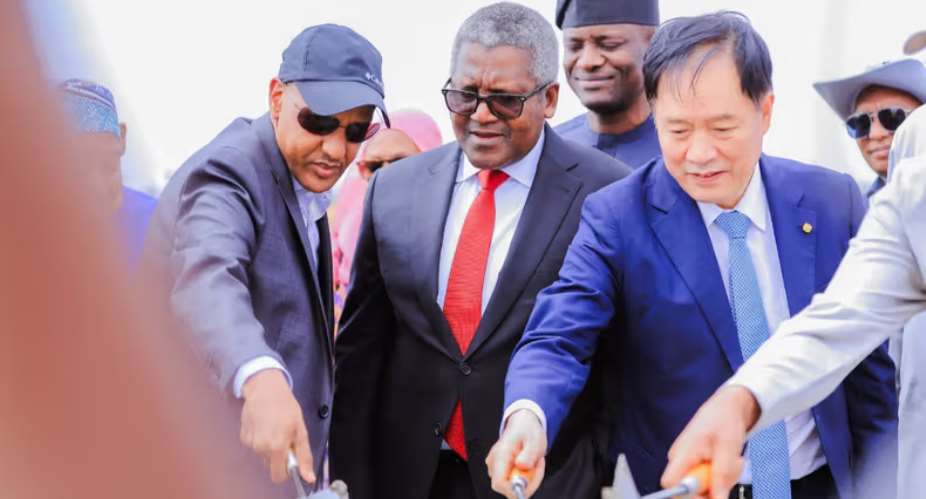
The approval was granted by Djibouti President Ismail Omar Guelleh during a high-profile meeting With Ethiopian officials, including the CEO of Ethiopian Investment Holdings, Brook Taye.
For Aliko Dangote, Africa’s richest man, this iS a major expansion of his business empire across the continent’s east coast. He iS already building a $4 billion fertilizer complex in Ethiopia’s Somali region, which Will include its own dedicated natural gas pipeline and a 120- megawatt power plant.
Orjgnally estimated at $2.5 billion, the project has expanded as additional infrastructure like pipelines and power generation were added. With the pipeline deal, Dangote iS essentially creating an integrated energy corridor from the Ethiopian hinterland to the Red Sea. Why does this matter for Ghana? First, because it shows what iS possible when African capital and African ambition come together. Dangote iS not a Chinese state-owned enterprise. He iS not a Western multinational. He IS a Nigerian businessman who has built a pan-African industrial empire. His refinery in Nigeria, the largest in Africa, has transformed Nigeria from a fuel importer to a net exporter.
His fertiliser plants are helping African farmers access affordable inputs. And now, his pipelines in EastAfrica Will help unlock the energy potential of one of the continent’s fastest-growing economies. That iS a model. It says that African businesses can solve African infrastructure problems Without waiting for foreign aid or development finance.
Second, because it highlights the strategic importance of energy infrastructure. Ghana has its own energy challenges. The Tema Oil Refinery has struggled for years. We import most of our refined petroleum products. We have natural gas resources that are not fully utilised. The Dangote pipeline project iS a reminder that the countries that invest in energy infrastructure, pipelines, refineries, storage terminals, and power plants, are the ones that Will have reliable, affordable energy.
The ones that do not Will reman dependent on imports and vulnerable to global price shocks. Third, because it shows how landlocked countries can overcome geographic disadvantages. Ethiopia has no coastline, but it has found a partner in Djibouti, which has one of the best ports in Africa. The pipeline Will connect the two, creating a seamless logistics corridor. Ghana iS not landlocked, but we have landlocked neighbours, Burkina Faso, Mali, Niger, that depend on our ports for their imports and exports. If Ghana invested in similar pipeline or rail infrastructure to connect those countries, we could become a regional energy hub, earning transit fees and strengthening our economc ties With the Sahel.
Now, let me talk about the broader strategy behind Dangote’s East Africa push. The Nigerian billionaire iS reportedly looking to replicate the success of his massive 650,000-barrel-per-day refinery in Nigeria by establishing at least one crude refinery on Africa’s east coast.
The pipeline deal With Djibouti and Ethiopia provides the essential infrastructure to make that Vision a reality. Ethiopia has significant natural gas reserves in its Somali region. Dangote’s fertiliser complex Will use that gas as feedstock. The pipelines Will allow any surplus gas to be exported.
And if Dangote builds a refinery on the east coast, it could process crude Oil from Ethiopia, South Sudan, or other regonal producers, supplying fuel to East African markets that currently import from the Middle East and Europe.
This IS exactly the kind of value addition that African countries have been talking about for decades.
Instead of exporting raw crude Oil and importing refined products, why not refine it here? Instead of flaring natural gas, why not use it to make fertiliser or generate electricity? Dangote is doing it. Other African industrialists should follow. The pipeline project is also a geopolitical statement. Ethiopia has been landlocked since Eritrea seceded in 1993. Its only access to the sea was through Eritrea, but relations between the two countries have been tense.
Djibouti has become Ethiopia’s primary trade route, handling over 90 percent of its maritime trade. The pipeline Will deepen that relationship, making Djibouti even more critical to Ethiopia’s economy.
For Djibouti, the pipeline brings transit fees, investment, and strategc relevance. For Etliopia, it brings energy security and a path to export its own resources. For Dangote, it brings access to new markets and a new source of energy for his industrial complex. Let me also address the challenges. Pipelines are expensive and technically complex. They require security, because they can be targets for sabotage. They require maintenance, because leaks and corrosion are constant risks.
They require cooperation between governments, regulatory agencies, and private operators. The Dangote Group has experience building pipelines in Nigeria, where the environment iS challenging. But Nigeria IS not Djibouti. The terrain, the climate, the security situation, all are different. Execution Will be key. There iS also the question of financing. Dangote has deep pockets, but $4 billion for the fertiliser complex plus the cost of the pipelines iS a significant sum.
He has reportedly used his own equity and loans from African development finance institutions. But the scale of investment required for continent-wide energy infrastructure IS beyond any Single private company. Governments and multilateral institutions Will need to partner With the private sector to close the gap.