
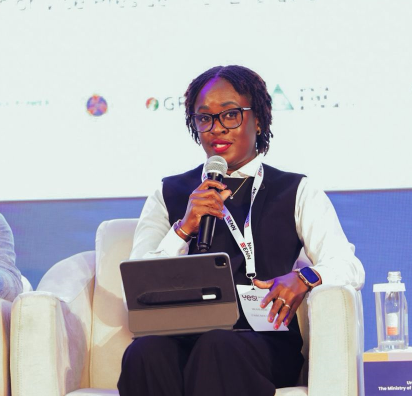
Stanbic Bank Ghana has emphasized that a solid and predictable financial structure remains the most decisive factor in determining whether an energy project can attract investment. This is according to Malaika Bakar, Senior Vice President for Energy and Infrastructure at Stanbic Bank Ghana.
Participating in a panel discussion at the Youth Energy Summit 2025, on the topic “Powering Ghana’s Future: Energy, the Master Key to Development”, Madam Bakar highlighted what banks prioritize before committing funds to large-scale energy ventures.
According to her, financial soundness forms the foundation of any bankable project. She noted that while technical feasibility and risk considerations are critical, financiers first examine whether a project demonstrates long-term, predictable cash flow and a balanced financing structure. “At its core, a bankable energy project must clearly show how it will generate adequate and predictable cash flows once operational. These cash flows must be enough to service debt, pay operating expenses and still create value for the project sponsors,” she said.
She explained that lenders look for financing arrangements that distribute risk responsibly between financiers and project sponsors. According to her, the presence of sponsor equity is a strong signal of commitment and significantly influences the bank’s decision-making process. “Project sponsors must have what we call ‘skin in the game’. Financing cannot rely on debt alone. Typically, we assess a debt-to-equity ratio of between 70–80 percent debt. The exact split depends on the project’s risk profile, but equity participation is non-negotiable because it demonstrates accountability and shared risk,” she explained.
Madam Bakar highlighted that an energy project lacking a clear financial structure or relying solely on external financing is unlikely to secure support from lenders. “No financier will provide 100 percent of the capital for a project. There has to be a balanced financial framework that gives confidence that the sponsors themselves are invested in the success of the project.”
She further explained that the bank evaluates whether the projected revenues can sustain payments over the entire lifecycle of the loan. This includes considerations such as the reliability of the off-taker and overall revenue security. “Even when the project has a strong concept, banks must be confident that revenues will consistently flow. If the financial model cannot demonstrate that, the project becomes too risky.”
She encouraged young professionals to deepen their understanding of financial modelling and project structuring, noting that these competencies will play a crucial role in Ghana’s energy transition. “There is a growing demand for talent in financial structuring, risk assessment and project analytics within the energy sector. Understanding how projects are built financially opens doors to significant opportunities.”