
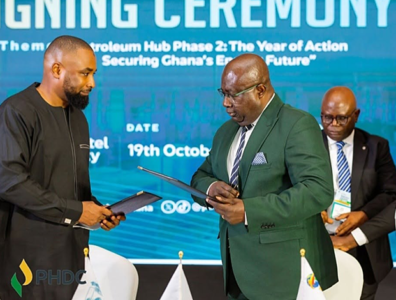
Ghana’s Petroleum Hub Development Corporation (PHDC) has signed a USD 28-billion agreement with an international investment consortium covering “Lot Two” of the Petroleum Hub project in Jomoro, Western Region. Tony Aubynn, CEO of the PHDC, described the agreement as a major milestone in moving the project from planning to implementation, calling it one of the largest industrial investments ever mobilised in Ghana and a sign of confidence in the country’s stability and economic prospects.
Under the agreement, Lot Two will comprise a refinery with a capacity of 300,000 barrels per stream day, two petrochemical plants, storage infrastructure with a stated capacity of 4 mcm, and a multi-berth jetty. Aubynn said the facilities are expected to be developed within five years, with initial construction at the Jomoro site scheduled to begin in the first quarter of 2027, subject to the completion of agreed preparatory requirements. The deal adds to a USD 12-billion agreement signed in June 2024 with the TCP-UIC Consortium for the project’s first phase, which covers a similarly structured refinery, a 90,000 bpd petrochemical plant, 3 mcm of storage, and jetty and port infrastructure. The wider Petroleum Hub is costed at around USD 60 billion and is planned across three phases between 2024 and 2036, eventually comprising three refineries, five petrochemical plants and 10 mcm of storage across more than 20,000 acres.
Aubynn said the project extends beyond petroleum infrastructure, with the potential to strengthen Ghana’s position in the regional energy industry and create opportunities across the economy, including for engineers, technicians, artisans, entrepreneurs, contractors and small businesses, as well as skills development, technology transfer, job creation and industrial growth more broadly. He linked the hub to the government’s energy security and industrialisation agenda, arguing that a fully operational facility could support President John Dramani Mahama’s 24-hour economy initiative, pointing to Singapore and Malaysia as examples of economies built around similar infrastructure.
Aubynn said the signing marks the start of a new phase of responsibility for the corporation, with the project’s success ultimately depending on translating the investment commitment into completed infrastructure, jobs and economic benefits for Ghanaians. “The true measure of our success will not be the agreement we sign, but the infrastructure we build, the investment we realise, the jobs we create, the industries we establish, and the lasting value we deliver to the people of Ghana,” he said.
source: theenergyyear.com