
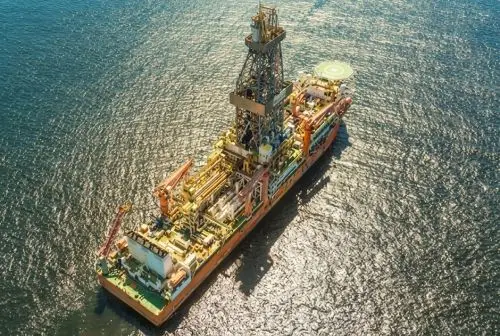
Nigeria plans to more than double its oil and gas reserves by intensifying exploration, particularly in deepwater areas and underexplored basins. Minister of State for Petroleum Resources Heineken Lokpobiri outlined the ambition on Tuesday, November 10, at the opening of the 44th Annual Conference of the Nigerian Association of Petroleum Explorationists (NAPE) in Lagos. To achieve this target, the government aims to accelerate upstream oil and gas operations.
On November 10, the Nigerian Upstream Petroleum Regulatory Commission (NUPRC) announced that it had approved 145 new drilling operations since the beginning of 2026, alongside 595 well re-entry operations and 39 field development plans. The regulator also reported 46 active drilling rigs.
Nigeria is also expanding seismic exploration to identify new hydrocarbon resources. According to the NUPRC, seismic data acquisition companies have invested more than $100 million in Nigeria since the Petroleum Industry Act came into force in 2021. The data will help companies assess the resource potential of different basins and prepare new exploration campaigns.
Deepwater Projects Drive Investment Strategy
Nigeria has introduced fiscal and regulatory reforms to attract international oil companies to capital-intensive offshore developments. In March 2024, President Bola Tinubu announced measures to improve investment conditions in the oil and gas sector. He subsequently approved a new fiscal incentive framework for deepwater offshore projects in August 2026.
Shell’s Bonga South West project, which the company is developing with its partners, reflects this strategy. The Nigerian presidency estimates the offshore development’s cost at approximately $10 billion. The government expects the new incentives to improve investment conditions for projects of this scale.
In August 2026, NNPC Ltd and its partners in oil mining lease OML 118 signed contractual amendments to advance the Bonga South West development. The agreements aim to facilitate progress on the project, which could attract between $15 billion and $21 billion in investment over its lifetime.
More broadly, the NUPRC estimates that operators could initiate 22 major offshore projects between 2026 and 2030, representing potential investment of $30 billion to $50 billion.
The regulator also reports that it has approved more than $57 billion worth of field development plans since 2024. Some of these projects have already reached final investment decision (FID).
In October 2026, Nigeria launched another oil and gas licensing round covering 40 blocks across onshore, shallow-water and deepwater areas.
Local Operators Gain Ground as International Majors Shift Focus
Nigeria’s efforts to attract offshore investment coincide with a broader restructuring of its upstream oil and gas industry.
Several international oil majors have sold portions of their onshore assets to Nigerian companies, allowing domestic operators to expand their presence in hydrocarbon production.
In March 2025, Shell transferred its subsidiary Shell Petroleum Development Company (SPDC) to the Renaissance consortium. Similarly, Italian energy group Eni sold Nigerian Agip Oil Company (NAOC) to Oando in August 2024.
ExxonMobil also completed the sale of its onshore and shallow-water assets to Seplat Energy in 2024 for approximately $1.28 billion. These transactions have increased the role of Nigerian producers in the country’s upstream oil and gas industry.
Meanwhile, Shell and Eni have retained interests primarily in natural gas and capital-intensive deepwater offshore operations.
Source: ecofinagency.com