
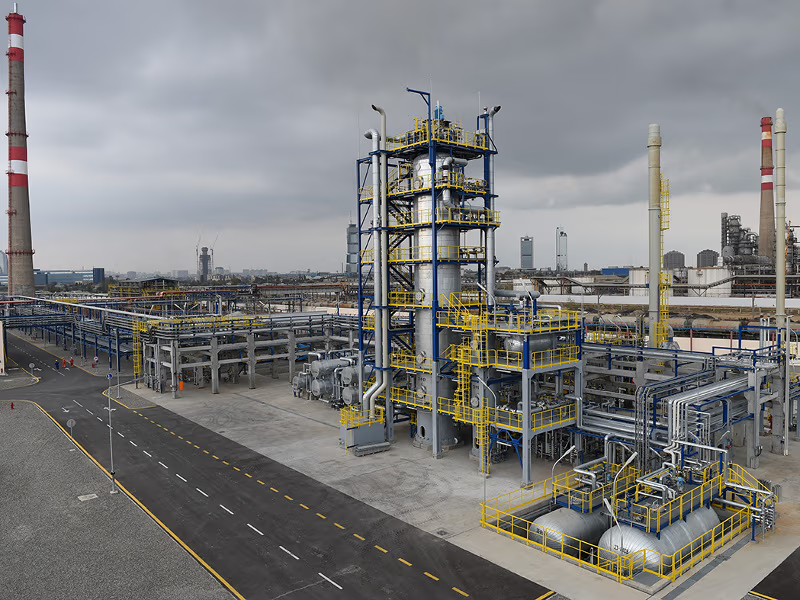
The closure of the Strait of Hormuz, through which roughly a fifth of global oil supply transits, has laid bare a vulnerability that African governments had long acknowledged regarding continental dependence on imports, which has been insufficiently addressed.
- •With 50 out of 54 African countries classified as net importers of refined fuel, and the African Petroleum Producers Organisation estimating that 70% of refined products are sourced externally, the continent’s exposure to geopolitical disruption is structural, not incidental.
- •The consequences have been predictable: fuel shortages, inflationary pressure, currency depreciation, and downward revisions to growth forecasts.
- •Yet the crisis has also catalysed a wave of refinery investment announcements that deserves closer scrutiny.
Continental refining capacity is not negligible, with 21 facilities operating in North Africa, 14 in West Africa, and several in Southern Africa, but it has long been insufficient relative to demand.
Between 2024 and 2025, mid-level producers, including Côte d’Ivoire, Niger, and Ghana, announced plans for new facilities, signalling a broader shift in continental ambition. The clearest proof of concept remains the Dangote Refinery in Lagos: launched in 2024, the 650,000 b/d facility, reportedly built for USD 20 billion, has, according to industry observers, transformed Nigeria from a net refined fuel importer into a regional exporter, with several African nations now sourcing supply from the complex since the start of the Middle East conflict.
A planned expansion to 1.4 million b/d by 2028 would further consolidate its regional role, while Dangote’s plans to build a USD 15 billion to USD 17 billion refinery in Lamu, Kenya, could replicate this impact in East Africa.
Established international partners have accelerated their own positioning. Angola launched operations for the USD 470 million Cabinda Refinery in early May, the first built since the country’s independence in 1975, through a project led by UK-based Gemcorp, as it seeks to reduce a refined fuel import dependency running at 72% of domestic demand.
Angola is simultaneously in talks with China, its largest trade partner, over USD 4.8 billion in financing for the 200,000 b/d Lobito Refinery. Beijing’s footprint in the African hydrocarbons sector deepened further in April, with Fujian Xiang Xing Corp. launching a USD 1.1 billion, 60,000 b/d refinery in Ndola, Zambia, where the annual oil import bill reached USD 2.1 billion in 2024.
Chinese firms Sanjiang Chemical and Xingcheng Fuzhou Industrial Park have also signed an MoU with the Nigerian National Petroleum Corporation to rehabilitate non-functional state-owned refineries in Port Harcourt and Warri. These developments underscore the combination of private sector interest and political will from governments to pursue these ventures, with the scenario expected to accelerate in the near to medium-term and attract more interested partners.
The ongoing war has led to deadly protests against fuel price increases in Kenya and the Comoros, with a prolonged conflict potentially contributing to the outbreak of further protests across Africa. In parallel, the war is expected to cause a spike in the estimated USD 50 billion spent annually on refined fuel imports by African countries, with Malawi declaring it will sell gold reserves to support fuel purchases. Meanwhile, Senegal intends to raise its subsidy allocation for 2026 to USD 2 billion compared to the pre-conflict approved figure of USD 443.8 million.
The UAE is positioning itself as a key stakeholder in addressing Africa’s structural fuel-processing constraints, with Emirati firm Alpha MBM Investments carrying out a USD 4 billion refinery project in Uganda, set for completion in 2028 and described as the country’s first such facility. Dubai-headquartered C-Star Petroleum is spearheading a USD 622 million refinery in Cameroon, intended to restore domestic refining capacity following the 2019 explosion at the country’s previously operational plant.
Despite concerns that reconstruction demands at home will relegate Africa as a near-term investment priority, the UAE’s continental commercial footprint – which includes investing USD 110 billion between 2019 and 2023 – aligns with Abu Dhabi’s long-term economic diversification agenda, suggesting interest will not be unwound by the ongoing conflict. This is bolstered by the UAE’s integrated investment approach, which combines sovereign wealth exposure, private-sector project execution, and an expanding portfolio spanning energy, rail, and port infrastructure, which support the emerging continental oil refinery ecosystem.
The ongoing refinery push will contribute to building continental industrial capacity and African countries’ diversifying international partnerships to support these efforts.
The changing refinery investor landscape, which has been dominated by Chinese state-backed financing and traditional Western players, underscores that competition for influence in the sector is intensifying across multiple fronts. This situation potentially bodes well for African countries, as it will reduce reliance on a few actors and potentially stimulate investment from countries like the UAE, which is increasing its involvement in African energy projects.
Furthermore, the operationalisation of these projects will support the implementation of economic transformation and import substitution objectives, which have been outlined by the African Union’s Agenda 2063 and supported by the African Development Bank, Afreximbank, and the Africa Finance Corporation.
Source: kenyanwallstreet.com