
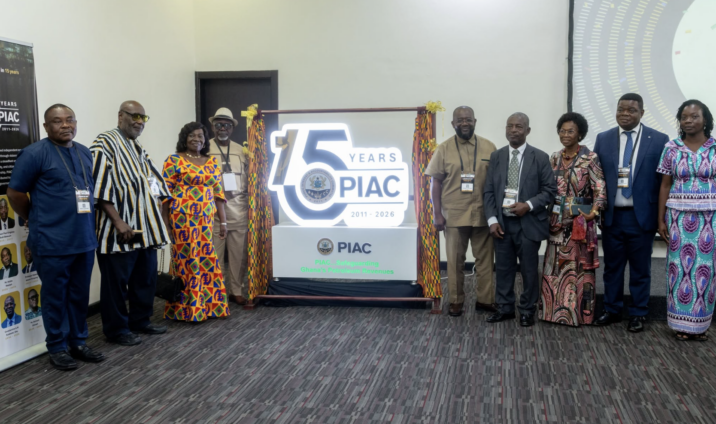
The Public Interest and Accountability Committee (PIAC) has marked 15 years of promoting transparency and accountability in Ghana’s management and use of petroleum revenues.
The Committee was established under the Petroleum Revenue Management Act, 2011 (Act 815), to monitor government’s compliance with the law, promote public participation in petroleum revenue management and provide independent assessments to support Parliament and the Executive in their oversight responsibilities.
Speaking at the launch its 15th anniversary celebrations in Accra, Mr Richard Ellimah, Chairman of PIAC, said the Committee had pursued its statutory mandate through the publication of reports, project inspections, public engagements and participation in policy discussions on petroleum revenue management.
He said the management of natural resources was a collective responsibility requiring the active participation of government, Parliament, oversight institutions, civil society organisations, the media, academia, traditional authorities, development partners and citizens.
Mr Ellimah urged the public and the media to continue demanding information, asking questions and participating meaningfully in discussions on the use of petroleum revenues.
Professor Akosua Darkwah, Chairperson of the anniversary occasion, said the 15-year journey of PIAC reflected Ghana’s recognition that the discovery of natural resources did not automatically translate into development.
She said the experience of oil-producing countries showed that development outcomes depended largely on decisions taken on the management and investment of resource revenues.
Prof. Darkwah cited Norway’s decision to invest surplus oil and gas revenues as an example of how deliberate choices could enable countries to convert natural resource wealth into long-term national development.
Mr Noble Wadzah, a former PIAC Chairman, said the Committee’s 15-year experience had demonstrated that transparency alone was insufficient to guarantee accountability.
He said the critical step was to ensure that recommendations contained in PIAC’s reports were acted upon by the relevant institutions.
“Transparency alone is not enough,” he said, stressing the need for stronger implementation of recommendations to deepen accountability in the management and use of petroleum revenues.
Mr Wadzah said PIAC had published 29 statutory reports during its 15-year journey, with some of its recommendations influencing public policy, legislation and decisions by state institutions.
He said the Committee had also undertaken project inspections to assess the effective use of petroleum revenues and engaged citizens to improve understanding of petroleum revenue management.
Mr Wadzah called for stronger financial and operational independence for PIAC, saying that was critical to the Committee’s ability to fulfil its mandate.
He also called for the protection of intergenerational equity safeguards and cautioned against
spreading petroleum revenues across numerous small projects, saying the finite nature of the resource required strategic and sustainable utilisation.
Mr Isaac Adongo, Chairman of Parliament’s Finance Committee, called for a clear legislative framework to guarantee PIAC’s funding, saying the Committee’s financial sustainability should not depend solely on discretionary government decisions.
He said Ghana needed a broader discussion on managing petroleum revenues to build wealth for future generations rather than consuming them predominantly in the present.
Mr Adongo cautioned that Ghana risked leaving future generations with an “empty bucket” if adequate safeguards were not maintained for the long-term saving and investment of petroleum revenues.
The anniversary was held on the theme: “PIAC at 15: Advancing Resource Governance through Transparency and Accountability for Sustainable Development.”
It provided an opportunity for stakeholders to reflect on PIAC’s contribution to petroleum revenue governance and consider reforms to strengthen its work in the years ahead.
source: PIAC marks 15 years of oil revenue accountability and transparency – MyJoyOnline