
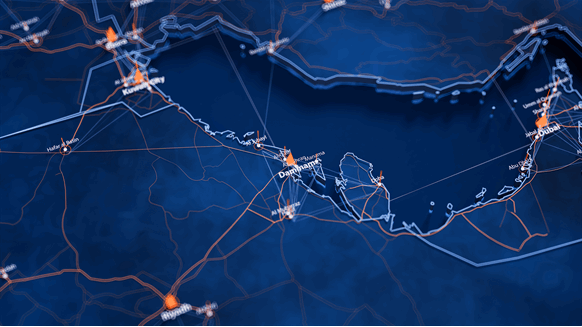
Oil loadings by Saudi Arabia and other major producers inside the Persian Gulf remained subdued as recent attacks continue to deter shipowners from traversing the Strait of Hormuz.
No large tankers have been seen berthed at the kingdom’s top Persian Gulf installations since July 12, according to satellite images from the European Union’s Sentinel-1 orbiter. The picture was slightly better at the main terminals across Iraq, the United Arab Emirates and Kuwait.
A spokesperson for the UAE Energy Ministry declined to comment. The Energy Ministries of Saudi Arabia and Kuwait didn’t respond to requests for comment. A spokesman for Iraq’s Oil Ministry said the number of vessels loading at the country’s berths “fluctuates depending on the prevailing conditions.”
Visible traffic through the Strait of Hormuz — which connects the Persian Gulf to international buyers — has been constrained again since the US-Iran peace deal fell apart. The escalation of hostilities between the US and Iran has prompted warnings from the UN’s shipping agency that the waterway was unsafe.
The disruption — which spread recently to include Yemen’s Bab el-Mandeb waterway that connects to the Red Sea — remains the largest of several supply crises whipsawing crude prices, squeezing consumers with high fuel costs and complicating central banks’ efforts to control inflation.
On Wednesday, Iran’s Islamic Revolutionary Guard Corps claimed to have “struck and brought to a halt” three tankers that were moving along an “illegal route,” state-run IRIB News reported. Naval authorities in the Middle East haven’t confirmed any attacks on vessels in the region.
Even so, traffic through Hormuz has picked up in recent days, with the US claiming its navy escorted some tankers across the waterway. The tanker Al Areesh openly exited the Persian Gulf early Thursday carrying the first shipment of liquefied natural gas from Qatar in several weeks.
If this flow continues, it could allow Middle Eastern producers to begin loading more cargoes.
Tensions have escalated in the Red Sea over the past week after at least one attack on a Saudi tanker by Iran-backed Houthi militants from Yemen. Still, two ships controlled by Dynacom Tankers Management Ltd. — one of the industry’s boldest shipowners during the Iran war — were observed heading for the Red Sea on Wednesday, according to tracking data.
The war has led to an increase in ‘dark’ activity that is difficult to quantify using conventional ship-tracking data. While satellite flyovers are intermittent and vary by location, the resulting imagery helps to capture a portion of these hidden trade flows, offering deeper insights into the pace and scale at which barrels are being exported from ports.