
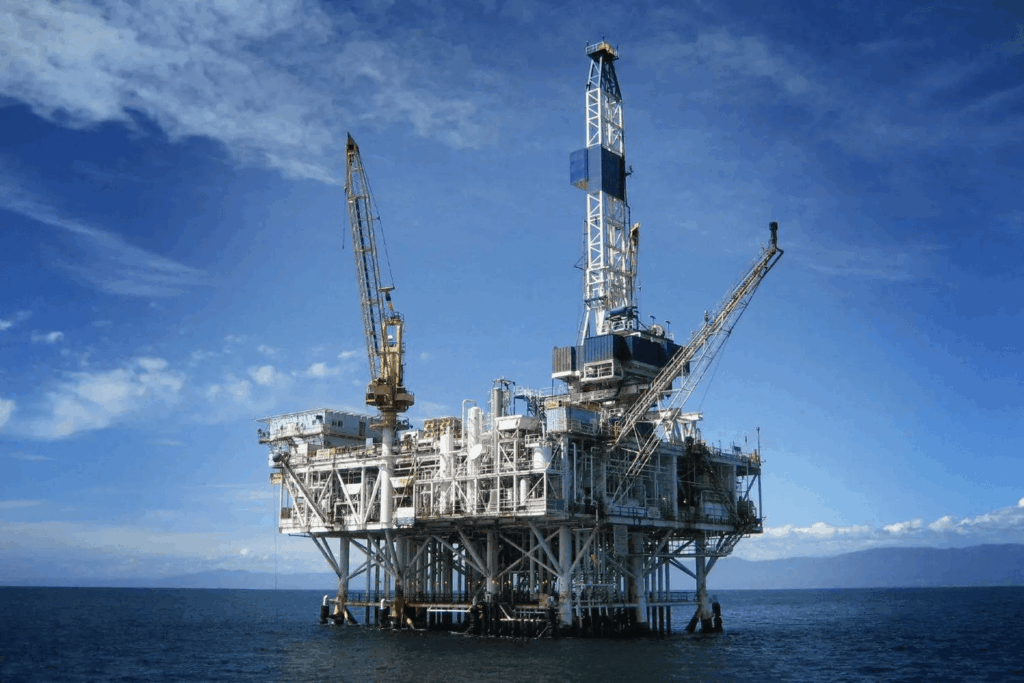
The country has secured more than US$3.5billion of fresh investment commitments from partners in its flagship Jubilee and Offshore Cape Three Points (OCTP) oil fields as government moves to reverse years of declining crude production and restore confidence in the upstream petroleum sector, Finance Minister Dr. Cassiel Ato Forson has said.
The commitments come after crude oil production nearly halved from 71.4 million barrels in 2019 to about 36 million barrels in 2025, raising concerns over sustainability of petroleum revenues and the future outlook of the country’s oil industry.
Presenting the 2026 Mid-Year Fiscal Policy Review to parliament, Dr. Forson said amendments to petroleum agreements covering the Jubilee and OCTP fields will support the drilling of at least 10 new wells, reduce Jubilee gas prices by about 18 percent, expand gas production and increase the Ghana National Petroleum Corporation’s (GNPC) participating interest in the two agreements by 10 percentage points from 2036.
Government believes the revised agreements, alongside broader upstream reforms, will help reverse declining production trends and attract additional capital into a sector facing aging fields and declining natural output.
The Public Interest and Accountability Committee (PIAC), in its latest petroleum receipts report, attributed the decline in petroleum revenues partly to lower crude production and weaker global oil prices while warning that limited exploration activity could undermine future output.
“No new Petroleum Agreement (PA) has been signed since 2018,” PIAC said, describing the situation as a threat to long-term production prospects and government revenues.
Dr. Forson said the recent reforms are already yielding results, with crude production and gas exports exceeding official projections during the first five months of 2026.
Between January and May 2026, Ghana produced 17.1 million barrels of crude oil and exported 86.1 billion standard cubic feet of gas. Production at the Jubilee field increased to about 95,000 barrels per day from a projected 68,000 barrels per day following the drilling of four new wells, while Sankofa output rose to 28,000 barrels per day.
Gas exports also increased to approximately 282 million standard cubic feet per day from 245 million standard cubic feet per day, according to the finance minister.
Beyond crude production, government is seeking to deepen domestic gas use in the power sector as part of efforts to reduce reliance on expensive liquid fuels.
Dr. Forson said gas supply for power generation had increased by an additional 35 million standard cubic feet per day by end-June 2026, bringing total supply to about 490 million standard cubic feet per day.
The increase comprises additional supplies from the Offshore Cape Three Points partners led by Eni and N-Gas, he said.
The expanded gas supply has already generated savings for the state, with government estimating that it saved GH¢3.08billion – equivalent to US$268.5million – during first half-2026 by replacing light crude oil with natural gas for electricity generation.
As part of efforts to strengthen gas infrastructure, government is also advancing plans for a 100 million standard cubic feet per day modular gas processing facility in partnership with the private sector.
Land acquisition for the facility has been completed, while environmental assessments, engineering design, financial due diligence and project structuring are ongoing. Financial close is expected before end-2026.
The project, according to the finance minister, is expected to create nearly 1,000 jobs and generate about US$2billion in benefits to the state over five years through fuel savings, foreign exchange savings, taxes, levies and dividends.
Meanwhile, negotiations are progressing for development of the Eban-Akoma discoveries, while new petroleum agreements in the Western, Central and Voltaian basins are also under discussion.
GNPC Explorco remains on course to commence exploratory drilling in the Voltaian Basin in fourth quarter-2026, as government seeks to unlock new petroleum frontiers beyond existing offshore producing areas.
Government is also reviewing the legal framework governing the upstream petroleum sector, with proposed amendments expectedly submitted to parliament before end of the year.
Dr. Forson said the reforms are intended to make the country more competitive for upstream investment as oil-producing jurisdictions compete for declining global exploration capital.
The Mid-Year Fiscal Policy Review, dubbed ‘Resetting for Growth, Jobs and Economic Transformation’, also highlighted ongoing efforts to improve the country’s energy security through new generation capacity – including the development of a 1,200-megawatt state-owned combined-cycle gas-fired power plant at Kafodzidzi-Abrobeano in the Komenda-Edina-Eguafo-Abrem municipality.
The first 600-megawatt phase is expected to be commissioned in 2028, with government saying the project will reduce generation costs and support electricity supply reliability.