
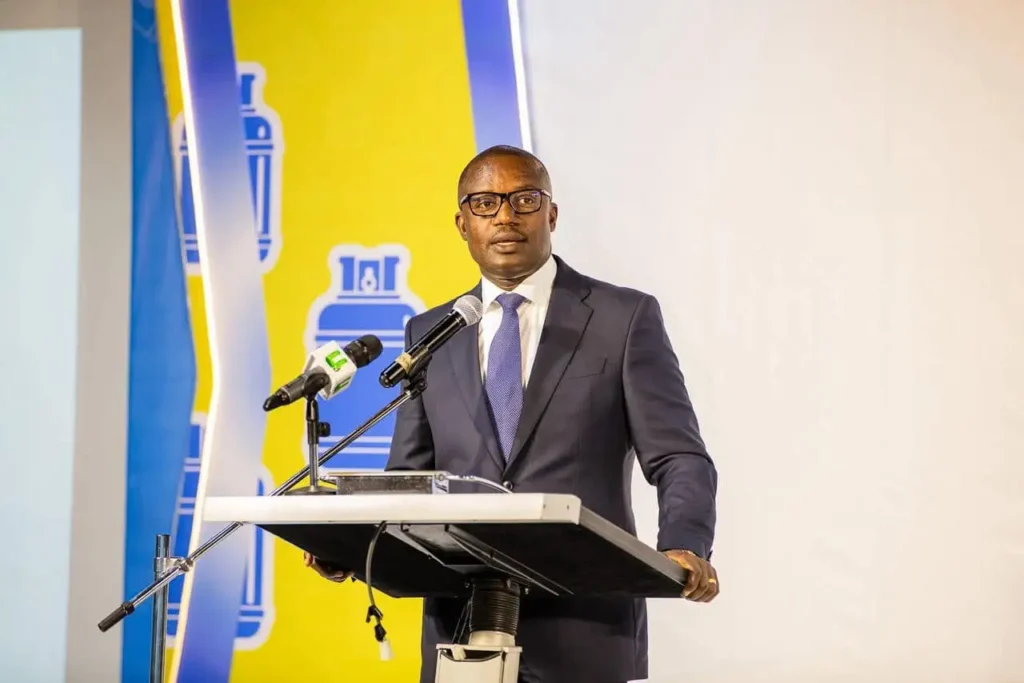
The Minister for Energy and Green Transition, Dr. John Abdulai Jinapor, has intensified the government’s call for a rapid transition to cleaner cooking alternatives, urging stakeholders nationwide to accelerate the adoption of Liquefied Petroleum Gas (LPG).
Speaking at the National LPG Forum organized by the National Petroleum Authority (NPA), Dr. Jinapor underscored that shifting away from traditional biomass fuels such as firewood and charcoal is a core pillar of the country’s National Energy Transition Framework.
The Ministry reports that Ghana has made notable progress, with national LPG penetration currently estimated at 43%.
The government, according to the Ministry of Energy and Green Transition, is working to ensure that at least 50% of the population adopts LPG for cooking by 2030.
“LPG remains one of the most environmentally friendly, viable, and immediately accessible cooking solutions to protect our forest cover, improve respiratory health outcomes, and reduce carbon emissions,” Dr. Jinapor stated.
To break down accessibility and safety barriers, the government is leaning heavily into the Cylinder Recirculation Model (CRM).
Rather than filling empty cylinders at traditional retail stations, the CRM allows users to seamlessly exchange empty cylinders for safely pre-filled ones at designated distribution points.
Substantial investments in commercial Cylinder Recirculation Plants in Tema and Kumasi now allow local networks to fill over 12,800 cylinders daily. Under the Liquefied Petroleum Gas for Development initiative, the Ministry has partnered with international donors to distribute two million domestic cookstoves and 200,000 commercial-sized stoves to first-time users by 2030.
The government has again mobilized six million dollars of an estimated eight million dollars required to retool the Ghana Cylinder Manufacturing Company Limited (GCMC), laying the groundwork to eventually ban the import of external cylinders and boost local industrial jobs.
Despite the structural growth, market leaders like the Chamber of Oil Marketing Companies (COMAC) have noted that retail pricing and sector taxes remain significant hurdles for lower-income households.
In response, Dr. Jinapor emphasized that the ministry is continuously reviewing fiscal frameworks to balance affordability with infrastructure sustainability.
“By shifting demand early, creating strategic localized distribution points, and supplying free starter kits to rural communities, Ghana aims to set a blueprint for realistic, socio-economically sound green transitions across West Africa,” he added.