
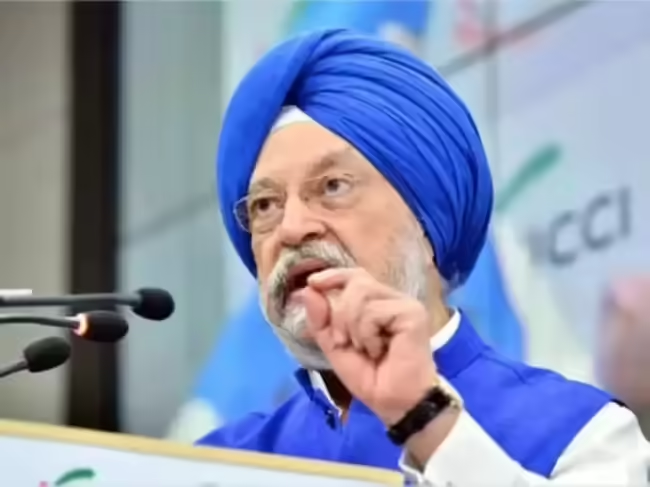
India can comfortably withstand a disruption in oil supplies through the Strait of Hormuz for about a month and does not expect crude prices to remain elevated for long, Petroleum Minister Hardeep Singh Puri told CNN-News18, citing the country’s fuel inventories, diversified sourcing strategy and expanding energy infrastructure.
Puri said India currently has fuel reserves equivalent to 76-80 days of consumption, including strategic petroleum reserves, refinery inventories and commercial stocks, providing a significant buffer against any near-term supply disruptions stemming from tensions in West Asia.
The minister said he remained confident that global supply shortages would be mitigated by producers outside the Gulf region and that additional gas supplies from Mozambique would further strengthen India’s energy security. “I don’t expect oil prices to be this high for a very long time,” Puri said, adding that he was not concerned about natural gas prices.
Addressing concerns over a potential closure of the Strait of Hormuz, a critical route for global oil shipments, Puri said adding that his comfort level was maintaining around 60 days each of crude oil, natural gas and LPG cover. He said India currently met that threshold and was therefore in a comfortable position.
Puri said the government had already activated diversified supply arrangements and cited discussions with UAE officials that helped secure additional LPG cargoes. He added that energy companies believed any near-term disruption could be managed.
However, the minister acknowledged that a much longer conflict would present a different challenge. While a short-term disruption could be absorbed through inventories and alternative supplies, a crisis extending well beyond current expectations could have wider implications for global energy markets.
Puri said India’s energy security framework extends beyond strategic petroleum reserves and includes inventories held by refiners and fuel retailers. He noted
that the country operates 24 refineries and continues to expand refining capacity, which he described as one of India’s biggest strengths during periods of global market volatility.
The minister rejected criticism that India failed to adequately fill its reserves when oil prices were low after the pandemic, saying fuel stock management involves continuous replenishment and commercial utilisation rather than simply storing crude indefinitely.
He argued that inventories are actively managed depending on market conditions and consumption requirements.
Puri also highlighted efforts to bolster the country’s broader energy infrastructure, including increased LPG storage capacity and higher domestic exploration spending. He said the number of LPG connections had risen to more than 33 crore from about 14 crore in 2014, while investments in exploration projects, including in the Andaman basin, were being stepped up.
He said India was also expanding domestic exploration activity, with state-run companies planning a significant increase in drilling activity, as part of a broader strategy to strengthen long-term energy security and reduce vulnerability to external shocks.
Despite heightened geopolitical uncertainty, Puri said India remained well positioned to manage potential disruptions through a combination of fuel stocks, diversified imports, refining capacity and strategic partnerships with overseas suppliers