
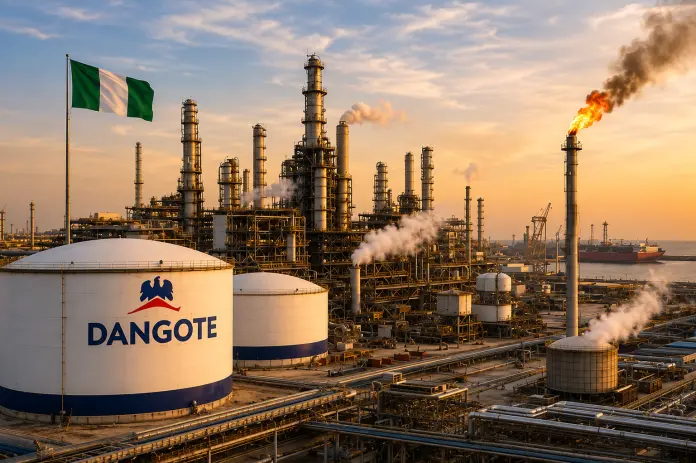
Dangote Petroleum Refinery processed 700,000 barrels of crude a day in a performance test, beating its 650,000 barrel nameplate capacity and advancing a plan toward global refining dominance.
The test, run by the plant’s process licensors, confirmed the Lagos facility as the world’s largest single train refinery, the company said. Owned by Nigerian industrialist Aliko Dangote, the refinery began producing fuels in 2024 and has quickly grown into a major supplier of refined products across Africa and beyond.
Devakumar Edwin, Vice President for Oil and Gas at Dangote Industries Limited, said the higher throughput is part of a strategy to lift capacity to 1.4 million barrels per day (bpd) within 30 months. Chief Executive David Bird, speaking at an industry conference in London, called the build out a “ruthless replication” of the original plant, with a new 700,000 bpd unit due online by the end of 2028.
Reaching that target would make the complex one of the largest refining operations in the world and deepen Nigeria’s push to capture more value from its crude after decades of exporting oil while importing fuel. The plant has helped cut reliance on imported gasoline, diesel and aviation fuel and eased pressure on foreign exchange reserves.
Rising output has drawn interest from international traders and crude suppliers, with the refinery sourcing feedstock at home and abroad. It now ships products to several African countries and to European markets including the United Kingdom, France, Spain, Italy and the Netherlands, and has exported gasoline to the United States and jet fuel to Saudi Arabia.
The momentum comes amid volatility tied to Middle East tensions, and the company says more African nations are buying from the plant to shore up fuel security. The refinery was reported by S&P Global Commodities Insights as the world’s largest jet fuel exporter in April.
Beyond transport fuels, the expansion is expected to boost supplies of liquefied petroleum gas (LPG), polypropylene and other feedstocks for packaging, consumer goods and petrochemicals. The company also plans to produce linear alkylbenzene (LAB), a key detergent ingredient, broadening Nigeria’s manufacturing base.
Executives say the project will create jobs, spur industrial activity and improve the trade balance as higher value exports climb.